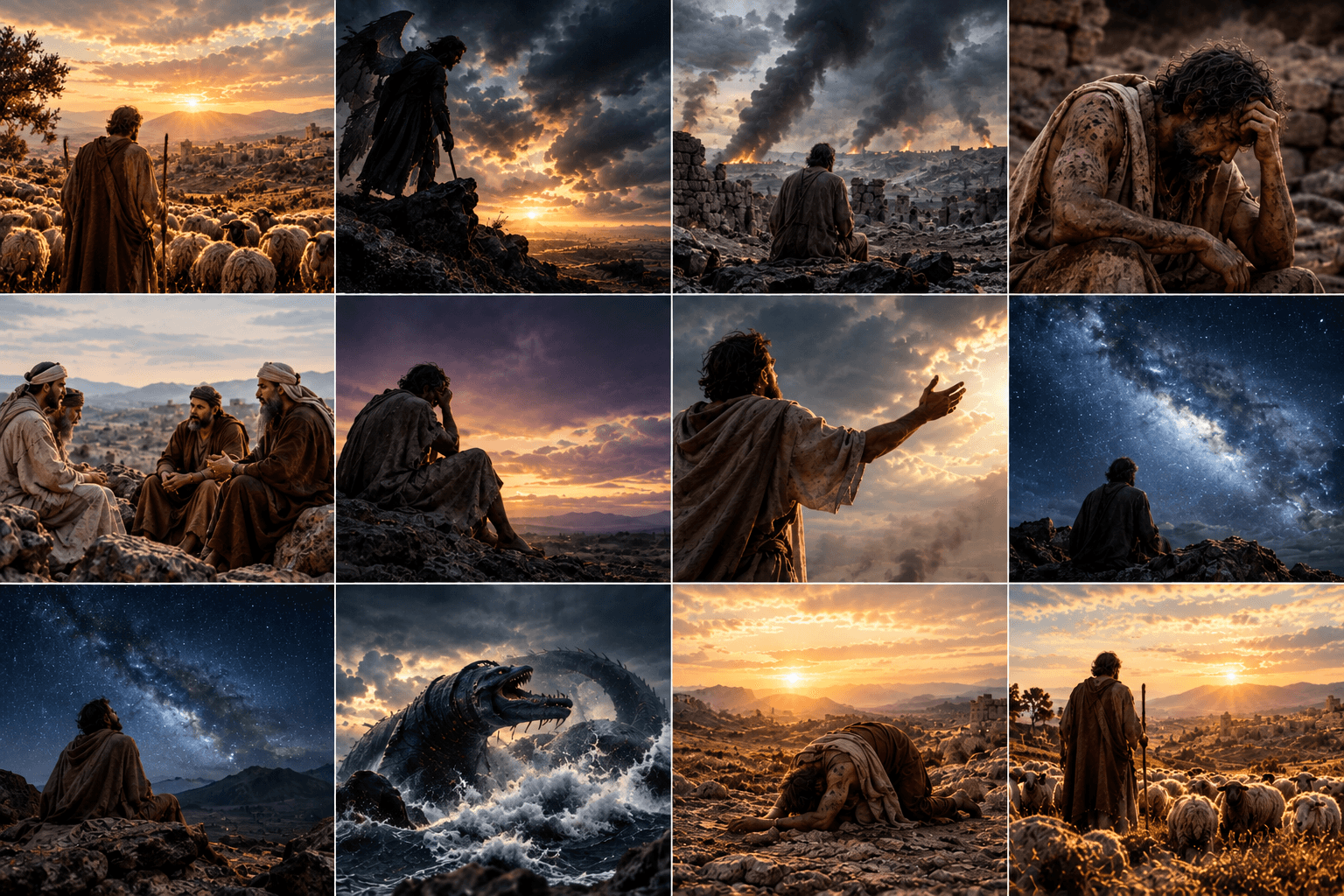
See who is speaking, whom they answer, what they assume, what is true, where truth is wrongly applied, and how the debate finally gives way to encounter.
The faces and scenes change as silence becomes lament, counsel becomes accusation, and argument gives way to encounter.
1-2
The hidden frame
Who is speaking?
Narrator, the LORD, the accuser, Job, Job's wife
Who or what are they answering?
The accuser challenges Job's motive; Job and his wife respond to catastrophe.
What claim is being made?
Will faith survive when blessing disappears?
What assumption is underneath it?
The accuser assumes faith is transaction.
What is true?
Job's integrity is established before the loss.
What is wrongly applied or limited?
Earthly observers do not know the heavenly scene.
How does the argument change?
Seven days of silence prepare for lament.
3
Lament breaks the silence
Who is speaking?
Job
Who or what are they answering?
Job answers the experience of unbearable life, not a prior human argument.
What claim is being made?
Why was life given to one whose way is hidden?
What assumption is underneath it?
Life should be addressable before its giver.
What is true?
Grief may speak truthfully to God.
What is wrongly applied or limited?
The friends hear lament as a confession of faulty theology.
How does the argument change?
Poetry replaces prose and opens the debate.
4-14
First debate cycle
Who is speaking?
Eliphaz, Job, Bildad, Job, Zophar, Job
Who or what are they answering?
Each friend diagnoses; Job tests the diagnosis against his case.
What claim is being made?
The friends argue that suffering reveals wrongdoing and repentance restores prosperity.
What assumption is underneath it?
Retribution is immediate and legible.
What is true?
God is just, creatures are limited, and evil matters.
What is wrongly applied or limited?
General truths are applied without evidence to Job.
How does the argument change?
Job's request grows from friendship to mediator and renewed life.
15-21
Second debate cycle
Who is speaking?
Eliphaz, Job, Bildad, Job, Zophar, Job
Who or what are they answering?
The friends intensify portraits of wickedness; Job names abandonment and appeals to a Redeemer.
What claim is being made?
The friends place Job inside the wicked person's fate.
What assumption is underneath it?
Job's losses make his identity obvious.
What is true?
Wickedness finally faces judgment.
What is wrongly applied or limited?
Bereavement and illness are treated as proof of guilt.
How does the argument change?
Job counters with the long prosperity of actual wicked people.
22-27
The debate collapses
Who is speaking?
Eliphaz, Job, Bildad, Job
Who or what are they answering?
Eliphaz invents crimes, Bildad shrinks to six verses, and Zophar does not return.
What claim is being made?
The formula must be preserved even if evidence must be supplied by accusation.
What assumption is underneath it?
A tidy system cannot be wrong.
What is true?
God knows the path and judges evil.
What is wrongly applied or limited?
Unsupported charges replace argument.
How does the argument change?
Job maintains integrity and the friends run out of answers.
28
Wisdom interrupts
Who is speaking?
Wisdom poem, precise voice disputed
Who or what are they answering?
The poem answers the entire failed human search.
What claim is being made?
Wisdom cannot be mined or purchased; God knows its way.
What assumption is underneath it?
Human mastery reaches a hard limit.
What is true?
Fear the Lord and turn from evil.
What is wrongly applied or limited?
Readers should not pretend certainty about the poem's speaker.
How does the argument change?
The book moves from debate toward testimony.
29-31
Job's final defense
Who is speaking?
Job
Who or what are they answering?
Job answers the whole accusation with remembered vocation, present shame, and an oath.
What claim is being made?
His life does not fit the crimes alleged.
What assumption is underneath it?
God's court should hear truthful testimony.
What is true?
Integrity has public, economic, household, and neighborly shape.
What is wrongly applied or limited?
Relative innocence must not become a claim of absolute sinlessness.
How does the argument change?
Job signs the case and waits.
32-37
Elihu changes the categories
Who is speaking?
Elihu
Who or what are they answering?
He addresses both Job and the failed friends.
What claim is being made?
Suffering may warn or instruct, and God may answer in ways humans miss.
What assumption is underneath it?
The strict punishment formula is incomplete.
What is true?
Wisdom is God's gift and divine justice is not transactional.
What is wrongly applied or limited?
A possible purpose must not be imposed as Job's certain diagnosis.
How does the argument change?
Argument yields to storm, wonder, and expectancy.
38-41
The LORD changes the frame
Who is speaking?
The LORD, with Job's brief response
Who or what are they answering?
God answers Job, but not by revealing the prologue.
What claim is being made?
Creation is wisely governed at scales Job cannot know or control.
What assumption is underneath it?
A creature cannot secure justice from the Creator's seat.
What is true?
God comes near and speaks; untamable powers remain creatures.
What is wrongly applied or limited?
Humility must not be used to forbid lament.
How does the argument change?
The question becomes who God is, not merely why an event happened.
42
Verdict, intercession, and gift
Who is speaking?
Job, the LORD, Narrator
Who or what are they answering?
Job responds to encounter; God judges the friends' speech and restores community.
What claim is being made?
The friends were wrong about Job, and Job must pray for them.
What assumption is underneath it?
Gift cannot be reduced to wages for sufficient faith.
What is true?
God corrects, forgives, receives prayer, and restores.
What is wrongly applied or limited?
The ending is not a universal promise of doubled earthly prosperity.
How does the argument change?
The book sends readers into life together with humility and hope.