Job 1 · Week 1
A Blameless Man and a Hidden Contest
Job's integrity is established before suffering begins. The reader learns what Job never learns: his losses are not punishment for a secret sin.
Open Job 1Complete chapter explorer
Every verse is accounted for in continuous ranges, with the speaker, argument, literary context, pastoral guardrails, Law, Gospel, and connections across the book.
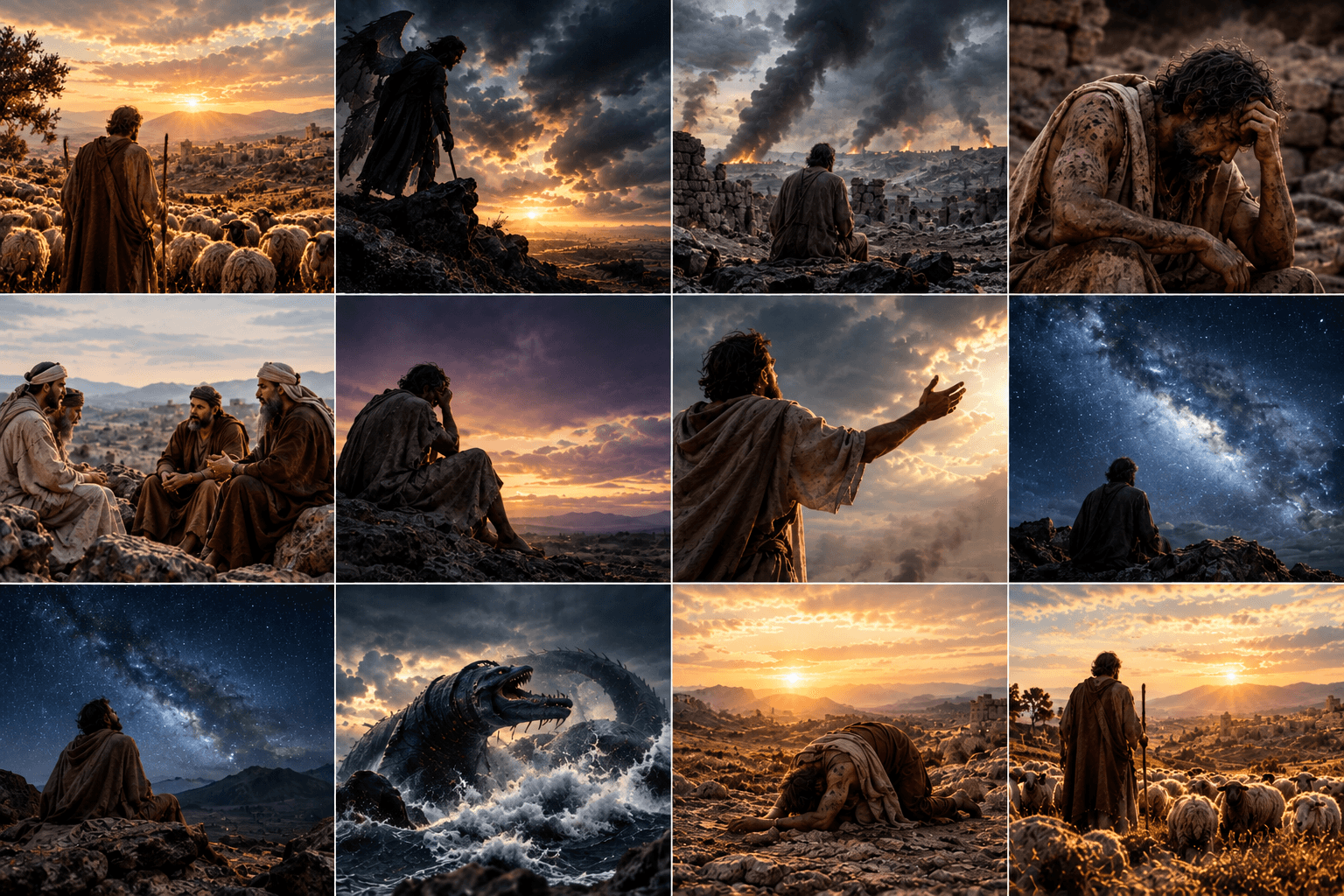
Job 1 · Week 1
Job's integrity is established before suffering begins. The reader learns what Job never learns: his losses are not punishment for a secret sin.
Open Job 1Job 2 · Week 1
Job loses health but retains integrity. His wife's grief-filled counsel and the friends' first week of silence introduce the human responses that will shape the book.
Open Job 2Job 3 · Week 2
Job's first speech gives grief a truthful voice. His death-wish language is lament, not a command for sufferers to harm themselves.
Open Job 3Job 4 · Week 3
Eliphaz recalls Job's former counsel, appeals to retribution, and treats a frightening vision as support for suspicion.
Open Job 4Job 5 · Week 3
Much of the language sounds orthodox, yet it is organized around an unproven diagnosis: Job must be under corrective discipline for wrongdoing.
Open Job 5Job 6 · Week 3
Job defends the extremity of his words, longs for death, and says his friends have become as unreliable as seasonal streams.
Open Job 6Job 7 · Week 3
Sleepless nights, bodily decay, and the brevity of life lead Job to ask why God watches him so closely and will not look away.
Open Job 7Job 8 · Week 4
Bildad rightly denies that God perverts justice, but wrongly treats the children's deaths and Job's suffering as transparent evidence of sin.
Open Job 8Job 9 · Week 4
Job confesses God's unmatched power and asks how a creature could obtain a hearing when the Judge is also the overwhelming Creator.
Open Job 9Job 10 · Week 4
He asks God to disclose the charge, remembers being intricately formed, and pleads for a little relief before death.
Open Job 10Job 11 · Week 4
Zophar mistakes Job's many words for empty talk, asserts that Job deserves worse, and offers prosperity after repentance.
Open Job 11Job 12 · Week 4
He mocks the friends' monopoly on wisdom, observes that sufferers and wrongdoers do not fit their formula, and confesses God's sovereign power.
Open Job 12Job 13 · Week 4
He risks direct speech to God because secondhand defenses have failed. The famous statement in verse 15 has a genuine textual and translation difficulty.
Open Job 13Job 14 · Week 4
Human life is brief and fragile. Job imagines being hidden until wrath passes and asks whether life can come again after death.
Open Job 14Job 15 · Week 5
Eliphaz accuses Job's speech of undermining reverence, appeals to ancient authority, and paints the wicked person's terror as Job's portrait.
Open Job 15Job 16 · Week 5
He describes God as assailant, the community as mockers, and yet says his witness and advocate are in heaven.
Open Job 16Job 17 · Week 5
Surrounded by mockery and dimmed eyes, Job asks God for a pledge and wonders whether hope can accompany him into dust.
Open Job 17Job 18 · Week 5
The wicked person's light is extinguished, steps are trapped, memory vanishes, and descendants disappear. The portrait mirrors Job's condition too closely to be accidental.
Open Job 18Job 19 · Week 5
Job names estrangement from God, family, servants, friends, and his own body. Then he asks that his words be permanently inscribed and confesses hope in a living Redeemer.
Open Job 19Job 20 · Week 5
He insists that wicked joy is brief, hidden poison becomes judgment, wealth is disgorged, and heaven reveals guilt.
Open Job 20Job 21 · Week 5
The wicked often live long, enjoy secure households, reject God, and die in peace. Immediate circumstances cannot serve as a reliable moral scorecard.
Open Job 21Job 22 · Week 6
Eliphaz now alleges concrete oppression without evidence, portrays Job as hiding from God, and again promises prosperity after repentance.
Open Job 22Job 23 · Week 6
Job longs to present an ordered case, trusts that God would pay attention, cannot locate God's presence, and fears the decree he cannot see.
Open Job 23Job 24 · Week 6
Boundary theft, oppression of the vulnerable, dangerous labor, adultery, murder, and theft all challenge the friends' claim that justice is immediately visible.
Open Job 24Job 25 · Week 6
Bildad celebrates God's dominion and purity, then asks how a mortal can be righteous. He does not answer Job's evidence about injustice.
Open Job 25Job 26 · Week 6
The dead tremble, Sheol lies open, the earth hangs over nothing, waters and heavens obey, and yet these are only the outskirts of God's ways.
Open Job 26Job 27 · Week 6
Job swears not to confess the friends' false charges, holds fast to integrity, and describes the ultimate insecurity of the wicked.
Open Job 27Job 28 · Week 6
Humans can mine earth's deepest places but cannot excavate wisdom. God alone knows its way, and human wisdom is to fear the Lord and turn from evil.
Open Job 28Job 29 · Week 7
Job recalls God's light, family flourishing, public respect, justice for the vulnerable, and a life that expected to end in peace.
Open Job 29Job 30 · Week 7
Young outcasts mock him, his body and dignity collapse, and God seems cruel and silent. Job's songs have become lament.
Open Job 30Job 31 · Week 7
Job invites judgment if he has committed sexual sin, deceit, injustice, idolatry, hatred, inhospitality, concealment, or land abuse. He signs the testimony and asks for an answer.
Open Job 31Job 32 · Week 8
Elihu is angry with Job for justifying himself rather than God and with the friends for condemning Job without an answer. He claims that understanding comes from God's breath, not age alone.
Open Job 32Job 33 · Week 8
He accurately restates parts of Job's complaint, disputes the claim that God gives no answer, and describes dreams, pain, an angelic mediator, rescue, and restored praise.
Open Job 33Job 34 · Week 8
He rejects any injustice in God, insists rulers and poor alike belong to the Creator, and accuses Job of multiplying rebellious words.
Open Job 34Job 35 · Week 8
He argues that human evil or righteousness directly affects other humans rather than enriching or diminishing the transcendent Creator, and says many cries lack true appeal to God.
Open Job 35Job 36 · Week 8
He portrays God as mighty yet attentive, says affliction may open ears to instruction, warns against resentment and bribery, and turns toward creation's weather.
Open Job 36Job 37 · Week 8
Creation's weather displays power beyond human command. Elihu urges Job to stop and consider God's wonders, yet confesses that the Almighty is beyond finding out.
Open Job 37Job 38 · Week 9
Questions about earth, sea, dawn, death, weather, stars, and animals reposition Job within a world governed by wisdom far beyond human reach.
Open Job 38Job 39 · Week 9
God attends birth, habitat, strength, strange instinct, battle power, and flight in creatures Job neither manages nor fully understands.
Open Job 39Job 40 · Week 9
Job places his hand over his mouth. God asks whether Job would condemn divine justice to justify himself, then presents a mighty creature God alone can govern.
Open Job 40Job 41 · Week 10
No human can domesticate, bargain with, capture, or withstand Leviathan. Yet the creature is neither God's rival nor outside God's ownership.
Open Job 41Job 42 · Week 10
Job confesses creaturely limitation after seeing God, the LORD rebukes the friends, Job intercedes for them, and his latter life is received as gift.
Open Job 42