A Scripture Week by Week journey
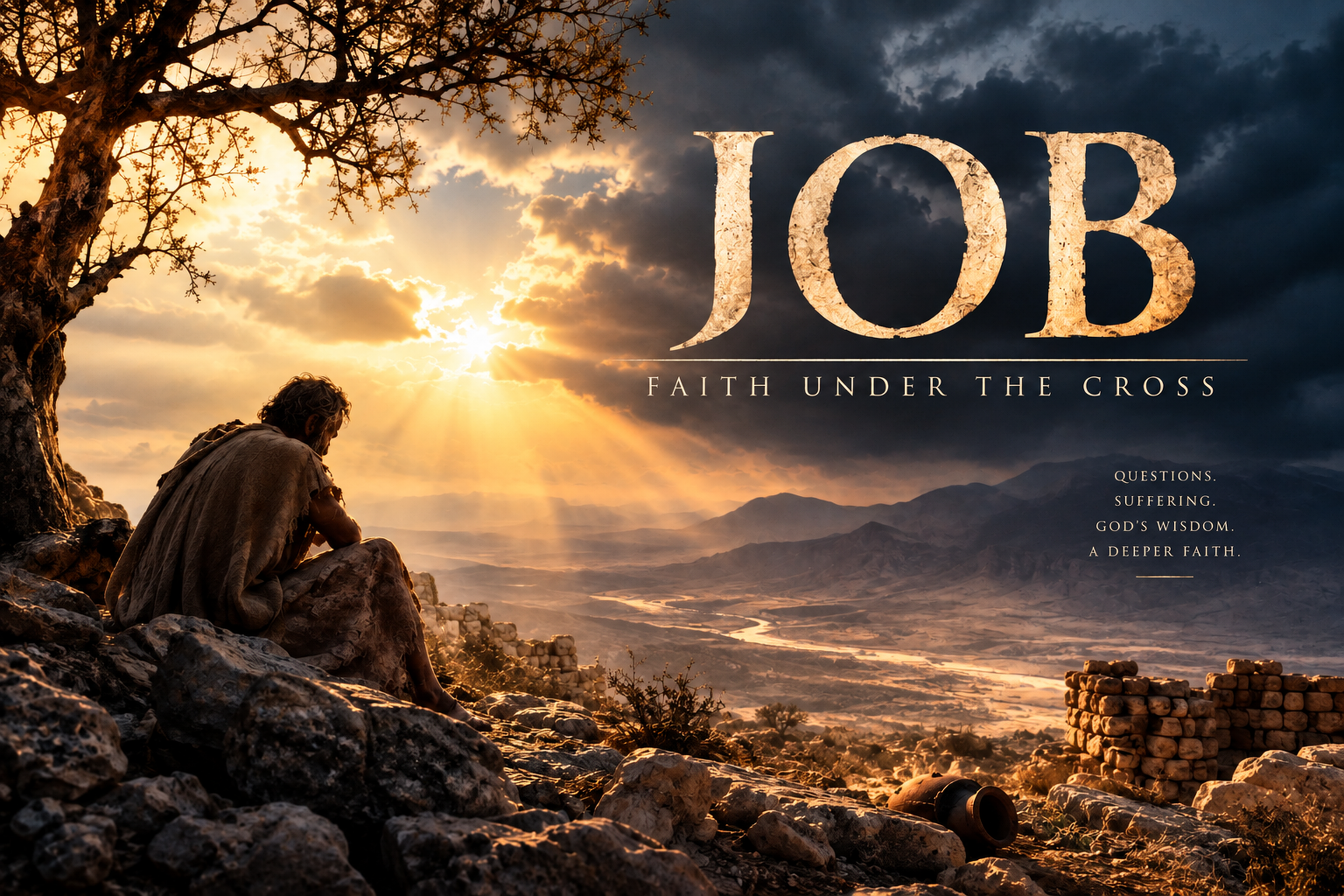
Job: Faith Under the Cross
A 12-Week Journey Through All 42 Chapters
Walk from loss through lament, debate, longing, wisdom, encounter, repentance, intercession, and hope, learning faith that rests in God when his hidden purposes cannot be explained.
The big question
Can faith remain faith when blessings disappear?
Job asks how a believer prays when God seems silent, why righteous people suffer, what creatures can know about hidden purposes, and what happens when correct theology is applied incorrectly.
Why do righteous people suffer?
What happens when correct theology is applied incorrectly?
Where does Christian hope finally rest?
How Job works
A book of scenes, speeches, and changing voices
The prose frame surrounds a long poetic conversation. Each movement raises the stakes until the LORD changes the entire frame.

Job 1-2
Prologue
The reader sees the earthly loss and the hidden heavenly challenge.
Job 3
Lament
Job gives anguish a truthful voice before God.
Job 4-27
Debate
Friends and Job test competing accounts of suffering and justice.
Job 28
Wisdom
Human mastery reaches its limit before the wisdom known by God.
Job 29-31
Final defense
Job places his vocation, integrity, and appeal before God.
Job 32-37
Elihu
A younger voice reframes suffering and prepares for the storm.
Job 38-41
The LORD answers
The Creator changes the frame through the wonders and wildness of creation.
Job 42
Response and restoration
Job responds, the friends are corrected, and intercession restores fellowship.
12-week journey
Shadow, question, encounter, light
Week 1 · Job 1–2
Faith When the World Breaks
Job's suffering is not introduced as punishment for hidden wickedness. The opening test asks whether God is worthy when visible gifts disappear.
Open Week 1Week 2 · Job 3
The Prayer of Anguish
Job curses the day of his birth, not God. Scripture makes room for anguish that keeps addressing God even when life feels unbearable.
Open Week 2Week 3 · Job 4–7
When True Words Become Bad Counsel
A theological sentence can be true in general and cruelly false as a diagnosis of a particular sufferer.
Open Week 3Week 4 · Job 8–14
Justice, Mortality, and the Longing for a Mediator
Job's need moves from an explanation to a hearing, an arbiter, and restored relationship with God.
Open Week 4Week 5 · Job 15–21
Accusation, Innocence, and the Prosperity of the Wicked
The friends' system hardens as Job's hope turns toward a witness and living vindicator who can answer abandonment.
Open Week 5Week 6 · Job 22–28
The Breakdown of Easy Wisdom
When a system must invent facts to survive, it has ceased to serve truth. Wisdom belongs to God and cannot be mined like human knowledge.
Open Week 6Week 7 · Job 29–31
A Life Laid Before God
Job's defense joins remembered blessing, present humiliation, and a public account of neighbor-directed righteousness.
Open Week 7Week 8 · Job 32–37
Elihu and the Storm on the Horizon
Elihu improves on simple retribution by treating suffering as possible warning or formation, yet he still knows more about Job's case than the prologue warrants.
Open Week 8Week 9 · Job 38–40
Where Were You?
The LORD answers Job by widening the frame from one disputed case to a creation whose wise governance exceeds human knowledge and utility.
Open Week 9Week 10 · Job 41–42
Leviathan, Repentance, Intercession, and Gift
Job abandons his prosecutorial posture, God rebukes the friends, and restoration arrives as gift rather than proof of a prosperity formula.
Open Week 10Week 11 · Whole book
Faith Under the Cross
Faith does not require access to God's hidden purposes. It clings to God's revealed mercy in the crucified and risen Christ.
Open Week 11Week 12 · Whole book
Living With Job
Job trains the church to accompany sufferers, refuse false accusation, pray honestly, and locate hope in Christ rather than tidy explanations.
Open Week 12Explore all 42 chapters
Every verse belongs to the journey
Each chapter page follows every verse through continuous, validated ranges, while keeping speaker, argument, theology, pastoral care, and context together.
1Week 12Week 13Week 24Week 35Week 36Week 37Week 38Week 49Week 410Week 411Week 412Week 413Week 414Week 415Week 516Week 517Week 518Week 519Week 520Week 521Week 522Week 623Week 624Week 625Week 626Week 627Week 628Week 629Week 730Week 731Week 732Week 833Week 834Week 835Week 836Week 837Week 838Week 939Week 940Week 941Week 1042Week 10
Follow the voices
Hear each speaker in context
No character is flattened into a slogan. Track what each voice sees, assumes, gets right, and wrongly applies.
Narrator
Frames the story and gives readers knowledge withheld from the human speakers.
Follow NarratorJob
Sufferer, lamenter, disputant, intercessor, and the central human voice.
Follow JobJob's wife
Job's surviving spouse and a fellow bereaved parent whose single recorded sentence comes from shared catastrophe.
Follow Job's wifeThe accuser
A subordinate heavenly challenger who questions the motive of Job's fear of God.
Follow The accuserEliphaz
The first friend to speak and the dominant voice among the three friends.
Follow EliphazBildad
A defender of divine justice who leans heavily on inherited wisdom.
Follow BildadZophar
The most abrupt friend, speaking twice with certainty about hidden guilt and swift judgment.
Follow ZopharElihu
A younger observer who speaks after the debate collapses and before the LORD answers.
Follow ElihuThe LORD
Creator, Judge, revealer, and giver whose speech changes the frame without disclosing the heavenly challenge.
Follow The LORDTrace the themes
Return to the book by question
Suffering
Job rejects the claim that suffering transparently reveals a specific personal sin and teaches patient accompaniment.
Trace themeRetribution
The friends turn final moral accountability into an immediate formula that Job's life and observations disprove.
Trace themeRighteousness
Job's relative integrity, universal creaturely sin, and God's justifying verdict must be carefully distinguished.
Trace themeWisdom
Human wisdom reaches its limit, while fear of the Lord and turning from evil mark the creaturely path.
Trace themeFear of God
The accuser questions whether reverence survives without reward; the book traces fear purified of transaction.
Trace themeLament
Lament gives grief truthful words before God without making anguish identical to unbelief.
Trace themePrayer
Job's protest, appeal, silence, and intercession show prayer as relationship grounded in God's invitation.
Trace themeJustice
All speakers affirm justice, but the debate asks whether creatures may map its timing or condemn a neighbor by outcomes.
Trace themeIntegrity
Job's wholeness appears in worship, truthful protest, resistance to false confession, and concrete neighbor-love.
Trace themeFriendship
The friends begin with faithful presence but make companionship conditional on Job accepting their diagnosis.
Trace themeFailed Consolation
True words become destructive when used to explain away suffering or manufacture guilt.
Trace themeGod's Hiddenness
Job cannot trace providence or access the prologue; faith must not turn the hidden will into speculation.
Trace themeStudy your way
Personal, household, group, youth, leader, or sermon preparation
Begin with the assigned Scripture. Then use chapter orientation, speaker tracking, Law and Gospel, discussion prompts, prayer, and leader notes at the depth your setting needs.
Personal study
Read one chapter page at a time and keep a prayer journal.
Family or youth
Choose one range, one image, one question, and the prayer.
Small group
Use a weekly guide, speaker tracking, and the provided activity.
Leaders and sermons
Follow the argument, disputed texts, canonical connections, and source notes.
Find your place