Narrative orientation
Where we are
Jesus raises Lazarus, reveals His glory through grief and life, and moves the authorities toward the plot that brings His hour near.
Narrative magnification
Scenes in This Chapter
Follow the story's natural units, then return here to open the existing verse-by-verse study.
Watch, listen, and go deeper
Media companions for John 11
Begin with the biblical text, then use these clearly labeled Lutheran, Christian, and academic resources for orientation, teaching, and deeper study.

Congregational Course: John
Concordia Seminary, St. Louis
Focused video lessons from Dr. Charles Gieschen and Dr. David Lewis on the text, structure, Christology, signs, glory, and Spirit in John.
Open video resource (opens in a new tab)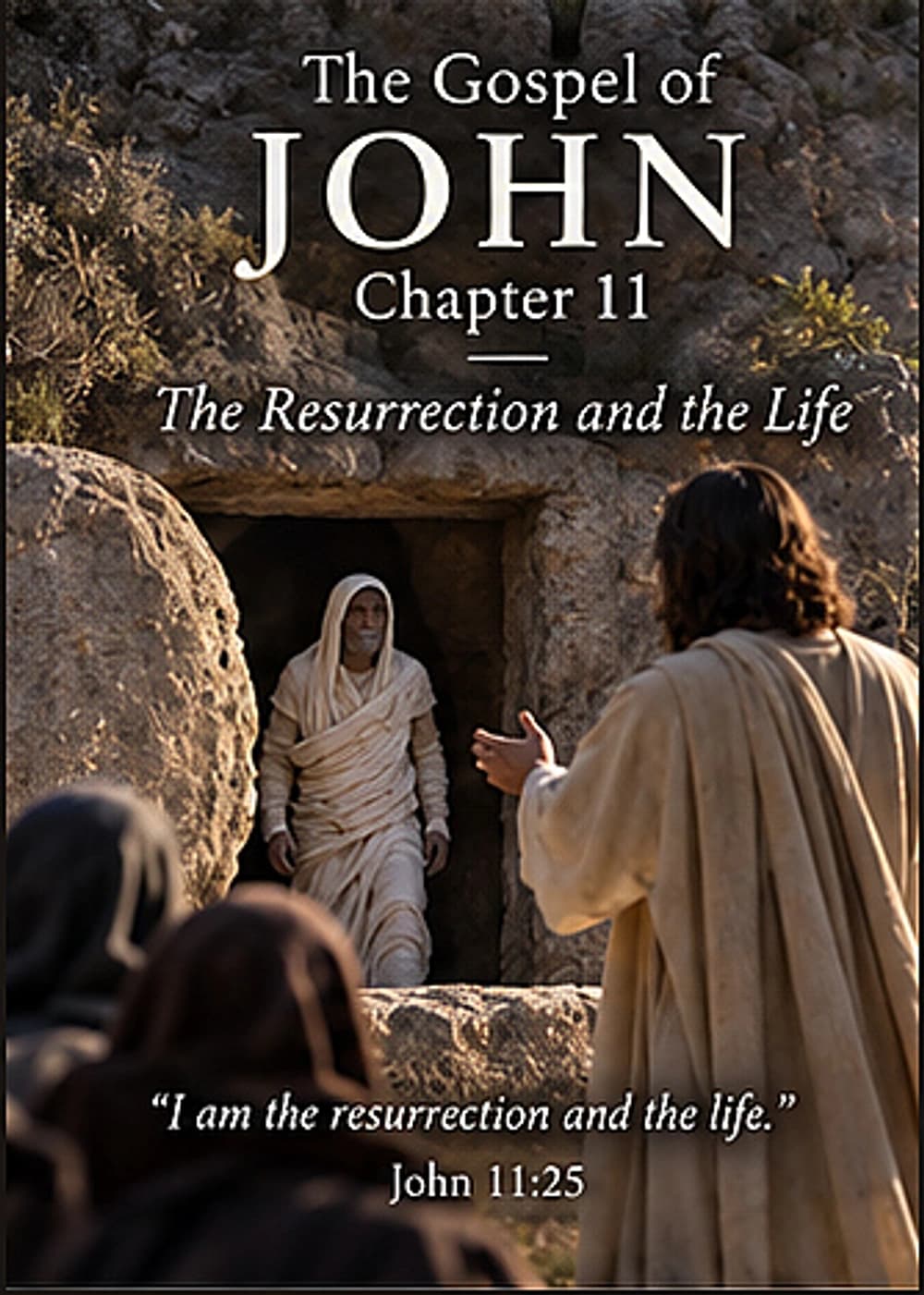
Eternal Life
BibleProject
A short biblical-theology video that helps readers trace the life Jesus gives in the present and in the resurrection.
Open video resource (opens in a new tab)
Guide to the Gospel of John
BibleProject · Two videos, 8:46 and 8:32
Two concise visual overviews introduce John's literary movement, signs, discourses, death, and resurrection. Use as orientation alongside the site's Lutheran theological study.
Open video resource (opens in a new tab)
Jesus in All of John
Spoken Gospel on YouVersion
Fifteen short, Christ-centered videos cover John in compact passage ranges from the prologue through the lakeside restoration.
Open video resource (opens in a new tab)
Thy Strong Word: Gospel of John
KFUO Radio
A consecutive, pastor-led study through John from the official broadcast voice of the LCMS. Use the collection to find the episode for this chapter.
Open audio resource (opens in a new tab)30 Minutes in the New Testament: John
1517
An accessible Lutheran conversation that begins with John 1:1-18 and continues sequentially through the Gospel.
Open audio resource (opens in a new tab)Gospel of John Lectures and Studies
Concordia Theological Seminary, Fort Wayne
Dr. William Weinrich's John lectures and focused treatments of passages including John 10 and John 11.
Open audio + video resource (opens in a new tab)Verse-by-verse Bible study
Read every verse, then follow it deeper
The complete WEB text is always visible. Select a verse for passage setting, themes, exegetical study, theological connections, application, prayer, and supplied Greek text.
The World English Bible text is public domain and reproduced from the official 2020 stable eBible.org source. Study and deep-dive material synthesizes the supplied South Lake Church John compilations and the existing research library. Scripture governs every note.
John 11:1-16
This illness is for God's glory
Jesus loves the family yet delays, moving deliberately toward a sign that will also accelerate His death.John 11:17-37
Jesus meets Martha and Mary
Jesus receives lament, promises resurrection, elicits confession, and enters human grief with tears and indignation.John 11:38-44
Lazarus, come out
Jesus prays publicly to the Father and calls the dead man from the tomb.John 11:45-57
It is better that one man die
The greatest public sign produces faith and a death plot; Caiaphas unknowingly announces substitution and gathering.Natural literary ranges
Passage-by-passage study
John 11:1-16
This illness is for God's glory
Jesus loves the family yet delays, moving deliberately toward a sign that will also accelerate His death.- Narrative setting
- Jesus is across the Jordan when news arrives from Bethany.
- Who is speaking
- Jesus, disciples, Thomas, messengers
- What is happening
- Jesus interprets the illness, waits, announces Lazarus's death, and returns toward danger.
- What this reveals about Jesus
- Jesus acts from love even when His timing is opaque and goes to awaken the dead at cost to Himself.
- Faith and unbelief
- The disciples misunderstand 'sleep,' but Jesus intends the sign to serve their belief.
Verse-by-verse movement
- The sisters appeal through Jesus' love.
- Jesus names glory as the final horizon.
- Love and delay stand together.
- Daylight imagery frames obedient movement.
- Sleep is clarified as death.
- Jesus goes to awaken Lazarus.
- Thomas voices loyal but dark resolve.
Scriptural connections
Elsewhere in John: John 2:4; John 12:23-28
Coram Deo
Faith cannot infer absence of love from delayed rescue; Jesus' path remains governed by glory and resurrection.
Christus Victor
Jesus walks toward the realm of death in order to call His friend out.
Application
Receive Christ's word in faith, then let His gift take form in truthful love toward the neighbor.
Prayer
Lord Jesus, open our eyes to Your glory and keep us in Your word. Amen.
John 11:17-37
Jesus meets Martha and Mary
Jesus receives lament, promises resurrection, elicits confession, and enters human grief with tears and indignation.- Narrative setting
- Outside Bethany, four days after burial.
- Who is speaking
- Jesus, Martha, Mary, mourners
- What is happening
- Two sisters bring the same lament; Martha confesses, Mary weeps, and Jesus is deeply moved.
- What this reveals about Jesus
- Jesus does not merely teach resurrection as an event; He is the resurrection and the life, truly sharing human sorrow.
- Faith and unbelief
- Martha's doctrinal hope becomes Christ-centered confession; mourners remain divided over what Jesus could have done.
Verse-by-verse movement
- Martha meets Jesus with grief and trust.
- Jesus directs hope from the last day to His person.
- Martha confesses Christ and Son of God.
- Mary falls at Jesus' feet with the same lament.
- Jesus sees communal grief and is deeply moved.
- Jesus weeps.
- The crowd reads both love and an unresolved question.
Scriptural connections
Elsewhere in John: John 5:21-29; John 20:28-31
Wider New Testament: 1 Thessalonians 4:13-18
Gospel
Jesus meets grief with Himself: whoever believes in Him will live even through death.
Christus Savior
The Life enters the place of death and will exchange His life for Lazarus's and ours.
Application
Receive Christ's word in faith, then let His gift take form in truthful love toward the neighbor.
Prayer
Lord Jesus, open our eyes to Your glory and keep us in Your word. Amen.
John 11:38-44
Lazarus, come out
Jesus prays publicly to the Father and calls the dead man from the tomb.- Narrative setting
- At Lazarus's sealed cave tomb.
- Who is speaking
- Jesus, Martha, crowd, Lazarus
- What is happening
- The stone is removed, Jesus thanks the Father for the sake of hearers, and Lazarus emerges still wrapped for burial.
- What this reveals about Jesus
- Jesus is the Father's sent One whose commanding voice gives life to the dead.
- What this reveals about the Father
- The Father hears the Son; their communion becomes public witness for the crowd.
- Faith and unbelief
- The sign is explicitly ordered toward believing that the Father sent Jesus.
Verse-by-verse movement
- Jesus again confronts death with deep emotion.
- Martha names the body's decay.
- Jesus recalls the promise of glory.
- The removed stone exposes the human impossibility.
- Prayer displays Father-Son communion for the crowd.
- The loud command calls one dead man by name.
- The community is told to unbind and release him.
Scriptural connections
Old Testament: Ezekiel 37:1-14
Christus Victor
The voice of Jesus invades the tomb and death yields its captive.
Coram mundo
Only Christ raises the dead, yet the community receives a real vocation: unbind him and let him go.
Application
Receive Christ's word in faith, then let His gift take form in truthful love toward the neighbor.
Prayer
Lord Jesus, open our eyes to Your glory and keep us in Your word. Amen.
John 11:45-57
It is better that one man die
The greatest public sign produces faith and a death plot; Caiaphas unknowingly announces substitution and gathering.- Narrative setting
- Jerusalem council deliberations after reports from Bethany.
- Who is speaking
- witnesses, chief priests and Pharisees, Caiaphas, Jesus
- What is happening
- Some believe, others report, the council fears national loss, and Jesus withdraws as Passover nears.
- What this reveals about Jesus
- Jesus will die not only for the nation but to gather God's scattered children into one.
- Faith and unbelief
- The same sign generates faith and a hardened resolve to kill; unbelief becomes organized.
Verse-by-verse movement
- Many witnesses believe.
- Others carry the report to authorities.
- The council treats signs as a political threat.
- Caiaphas proposes one death for the people.
- The narrator reveals a larger divine meaning.
- The plot becomes official.
- Passover pilgrims wonder whether Jesus will come.
Scriptural connections
Old Testament: Isaiah 49:5-6; Isaiah 53:4-6
Wider New Testament: Ephesians 2:11-22
Law
Power can acknowledge undeniable works yet prefer control and self-preservation to truth.
Gospel
The death plotted by enemies becomes the saving death by which God gathers His scattered children.
Christus Savior
Caiaphas's political calculation is taken up into the divine purpose of one death for the people.
Application
Receive Christ's word in faith, then let His gift take form in truthful love toward the neighbor.
Prayer
Lord Jesus, open our eyes to Your glory and keep us in Your word. Amen.
Gather around the text
Study questions
- What stands out?
- What questions or tensions arise?
- What does this reveal about life with the Father through Christ?
- How does this shape Christian life this week?
Carry Forward
The raised Lazarus sits at table while Mary anoints Jesus for burial and the King enters Jerusalem.
Prayer Focus
For resurrection hope centered in Jesus and comfort for those who grieve.
Read Next
Follow the threads
Related paths
Related themes
Conversations
Places
Sources for this study
Holy Scripture governs this study. Later sources illuminate language, history, reception, and doctrine without standing above the text.
- The Gospel according to JohnPrimary source. The governing text for every chapter, structure, claim, and cross-reference.
- World English Bible, 2020 stable Protestant editionPublic-domain English translation. Provides the complete English verse text, reproduced without alteration from the official eBible.org USFM source.
- Supplied critical Greek text of the Gospel of JohnLanguage source. Provides Greek text for every verse present in the supplied edition, normalized only by removing display apparatus marks. John 5:4 is transparently marked as absent rather than reconstructed.
- The Gospel According to John: Exegetical Study, Greek Notes, Law and Gospel, and Teaching CompanionSouth Lake Church study compilation. Synthesized into chapter orientation, verse study, Greek anchors, canonical connections, theological reflection, questions, and application across John 1-21.
- Ancient Christian Commentary on Scripture, John 11-21Ancient Church reception. Used for attributed paraphrases and historical reception in the second half of the Gospel.
- R. C. H. Lenski, The Interpretation of St. John's GospelLutheran commentary. Consulted as a Lutheran exegetical voice, distinguished from Scripture and the Lutheran Confessions.
The supplied copyrighted books remain private research materials. Public pages use original synthesis, short terms, and attributed paraphrase without invented page numbers.