Narrative orientation
Where we are
Mary's devotion, Jesus' royal entry, and the grain of wheat announce that glory comes through His death.
Narrative magnification
Scenes in This Chapter
Follow the story's natural units, then return here to open the existing verse-by-verse study.
Watch, listen, and go deeper
Media companions for John 12
Begin with the biblical text, then use these clearly labeled Lutheran, Christian, and academic resources for orientation, teaching, and deeper study.
Congregational Course: John
Concordia Seminary, St. Louis
Focused video lessons from Dr. Charles Gieschen and Dr. David Lewis on the text, structure, Christology, signs, glory, and Spirit in John.
Open video resource (opens in a new tab)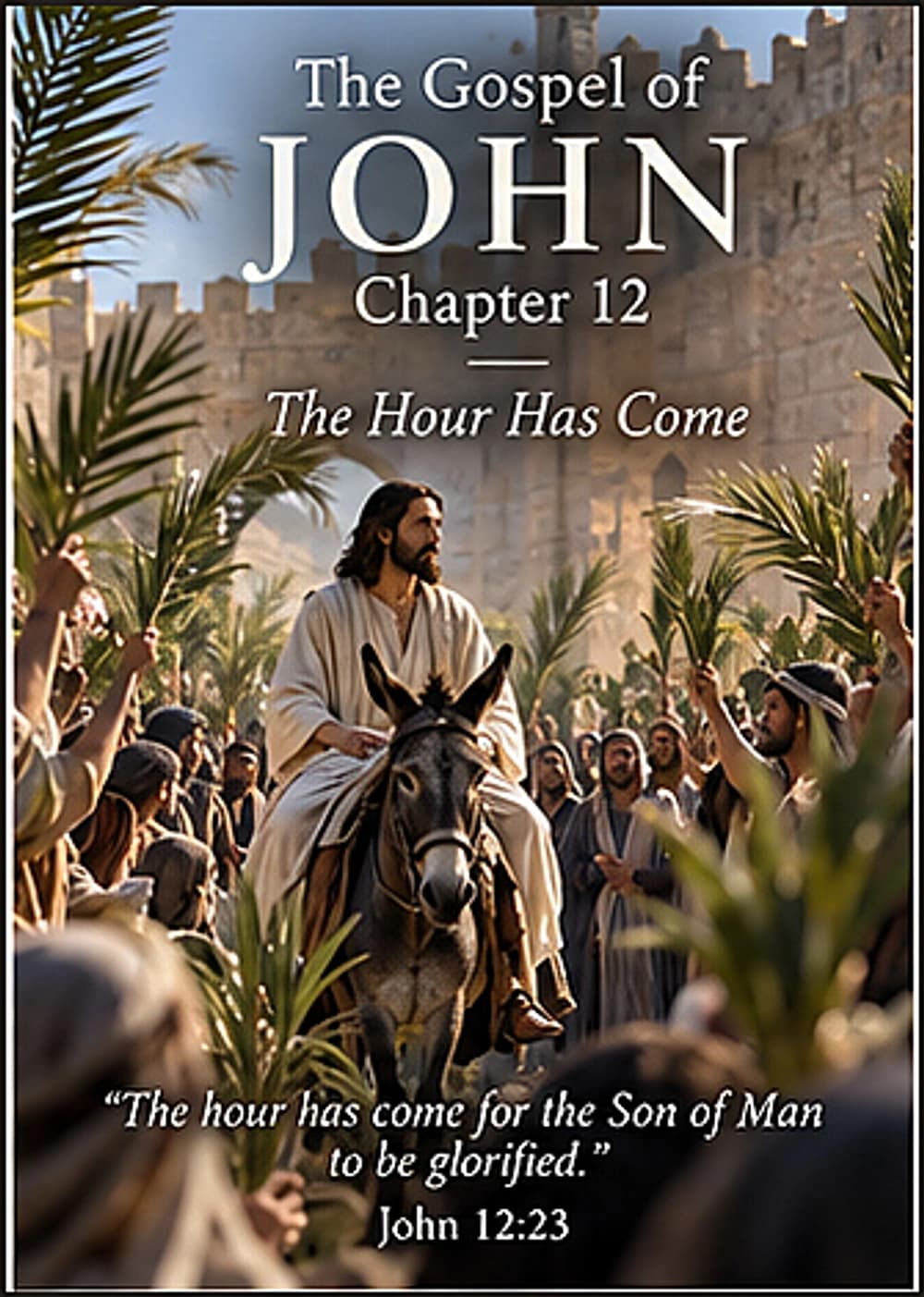
Guide to the Gospel of John
BibleProject · Two videos, 8:46 and 8:32
Two concise visual overviews introduce John's literary movement, signs, discourses, death, and resurrection. Use as orientation alongside the site's Lutheran theological study.
Open video resource (opens in a new tab)
Jesus in All of John
Spoken Gospel on YouVersion
Fifteen short, Christ-centered videos cover John in compact passage ranges from the prologue through the lakeside restoration.
Open video resource (opens in a new tab)
Thy Strong Word: Gospel of John
KFUO Radio
A consecutive, pastor-led study through John from the official broadcast voice of the LCMS. Use the collection to find the episode for this chapter.
Open audio resource (opens in a new tab)30 Minutes in the New Testament: John
1517
An accessible Lutheran conversation that begins with John 1:1-18 and continues sequentially through the Gospel.
Open audio resource (opens in a new tab)
Gospel of John Lectures and Studies
Concordia Theological Seminary, Fort Wayne
Dr. William Weinrich's John lectures and focused treatments of passages including John 10 and John 11.
Open audio + video resource (opens in a new tab)
Lectionary at Lunch: John
Concordia Seminary, St. Louis
Exegetical audio on many Johannine lectionary texts, frequently working directly with the Greek for pastors and serious students.
Open audio resource (opens in a new tab)Verse-by-verse Bible study
Read every verse, then follow it deeper
The complete WEB text is always visible. Select a verse for passage setting, themes, exegetical study, theological connections, application, prayer, and supplied Greek text.
The World English Bible text is public domain and reproduced from the official 2020 stable eBible.org source. Study and deep-dive material synthesizes the supplied South Lake Church John compilations and the existing research library. Scripture governs every note.
John 12:1-11
Anointed for burial
Mary's lavish devotion prepares Jesus for burial while Judas masks theft as concern for the poor.John 12:12-26
The King and the grain of wheat
Jesus enters as Israel's King and interprets His hour through a seed that dies to bear fruit.John 12:27-36
Lifted up to draw all
The troubled Son obeys the Father's purpose; the cross judges the world and casts out its ruler.John 12:37-50
Unbelief and the final public word
John interprets persistent unbelief through Isaiah while noting secret belief constrained by love of human glory.Natural literary ranges
Passage-by-passage study
John 12:1-11
Anointed for burial
Mary's lavish devotion prepares Jesus for burial while Judas masks theft as concern for the poor.- Narrative setting
- A supper in Bethany six days before Passover.
- Who is speaking
- Jesus, Mary, Martha, Lazarus, Judas
- What is happening
- Mary anoints Jesus' feet, Judas objects, and leaders expand the death plot to Lazarus.
- What this reveals about Jesus
- Jesus receives costly love and knowingly moves toward burial.
- Faith and unbelief
- Mary's embodied devotion contrasts with Judas's concealed unbelief and leaders' resolve to erase testimony.
Verse-by-verse movement
- The raised man sits at table.
- Mary fills the house with costly fragrance.
- Judas's objection hides exploitation.
- Jesus relates the act to burial.
- The poor remain neighbors to serve.
- Lazarus's life becomes dangerous evidence.
Scriptural connections
Elsewhere in John: John 11:2; John 13:21-30
Coram mundo
Love for Christ does not erase care for the poor; Judas's false opposition between them serves theft, not mercy.
Gospel
Jesus knowingly receives anointing for the burial through which He will save.
Application
Receive Christ's word in faith, then let His gift take form in truthful love toward the neighbor.
Prayer
Lord Jesus, open our eyes to Your glory and keep us in Your word. Amen.
John 12:12-26
The King and the grain of wheat
Jesus enters as Israel's King and interprets His hour through a seed that dies to bear fruit.- Narrative setting
- The road into Jerusalem and festival crowds.
- Who is speaking
- Jesus, crowds, disciples, Philip, Andrew, Greeks
- What is happening
- Palm acclamation, remembered Scripture, and Gentile seeking lead Jesus to announce the hour and call disciples to follow.
- What this reveals about Jesus
- Jesus is the humble King whose death bears much fruit and whose servants follow Him through self-giving life.
- Faith and unbelief
- Acclamation and seeking surround Jesus, but genuine following is defined by His cross-shaped hour.
Verse-by-verse movement
- The crowd receives Jesus with palms and royal words.
- Jesus fulfills the humble-king sign.
- Understanding comes after glorification.
- Lazarus witnesses draw the crowd.
- Greeks seek Jesus through disciples.
- The hour is announced.
- The grain dies and bears fruit.
- Servants follow where Jesus goes.
Scriptural connections
Old Testament: Psalm 118:25-26; Zechariah 9:9
Wider New Testament: Philippians 2:5-11
Coram Deo
Life is received by following Jesus rather than preserving the self as its own possession.
Coram mundo
The grain-of-wheat pattern shapes service and vocation without turning self-destruction into a virtue.
Christus Savior
The One dies so the many may receive fruit and life.
Application
Receive Christ's word in faith, then let His gift take form in truthful love toward the neighbor.
Prayer
Lord Jesus, open our eyes to Your glory and keep us in Your word. Amen.
John 12:27-36
Lifted up to draw all
The troubled Son obeys the Father's purpose; the cross judges the world and casts out its ruler.- Narrative setting
- Jesus answers the announced hour before the crowd.
- Who is speaking
- Jesus, Father's voice, crowd
- What is happening
- Jesus prays, the Father answers, and lifting up is interpreted as both death and universal drawing.
- What this reveals about Jesus
- Jesus is the obedient Son whose cross is glorification, judgment, victory, and invitation.
- What this reveals about the Father
- The Father glorifies His name in the Son's obedient saving hour.
Verse-by-verse movement
- Jesus' soul is troubled by the approaching hour.
- He refuses rescue from the purpose for which He came.
- The Father glorifies His name.
- The heavenly voice serves the crowd.
- The cross judges the world.
- The ruler of this world is cast out.
- The lifted Son draws all peoples.
- The Light remains briefly; hearers are summoned to believe.
Scriptural connections
Old Testament: Isaiah 52:13-53:12
Elsewhere in John: John 3:14-16; John 19:16-30
Christus Victor
At the cross the ruler of this world is cast out and the world's verdict is overturned.
Christus Savior
The lifted Son draws sinners to Himself through the death He willingly enters.
Application
Receive Christ's word in faith, then let His gift take form in truthful love toward the neighbor.
Prayer
Lord Jesus, open our eyes to Your glory and keep us in Your word. Amen.
John 12:37-50
Unbelief and the final public word
John interprets persistent unbelief through Isaiah while noting secret belief constrained by love of human glory.- Narrative setting
- Conclusion of Jesus' public ministry.
- Who is speaking
- Narrator / Evangelist, Jesus, Isaiah, leaders
- What is happening
- Signs, prophecy, fear, glory, seeing, hearing, salvation, and final judgment gather into a closing appeal.
- What this reveals about Jesus
- To see Jesus is to see the Father; His spoken word comes from the Father's command of eternal life.
- What this reveals about the Father
- Jesus' words and works transparently reveal the Father who sent Him and commanded eternal life.
- Faith and unbelief
- Unbelief persists in the face of signs; hidden belief fears exclusion and loves human approval.
Verse-by-verse movement
- Many signs have not produced belief.
- Isaiah names both rejected report and hardened sight.
- The prophet saw Jesus' glory.
- Some rulers believe but fear confession.
- Human glory competes with God's glory.
- Jesus' public cry joins faith in Him to faith in the Sender.
- His mission is saving light.
- His word will judge because it is the Father's life-giving command.
Scriptural connections
Old Testament: Isaiah 6:1-10; Isaiah 53:1
Law
Love of human glory can keep real conviction from becoming public confession.
Gospel
Jesus comes as saving Light, speaking the Father's command that is eternal life.
Application
Receive Christ's word in faith, then let His gift take form in truthful love toward the neighbor.
Prayer
Lord Jesus, open our eyes to Your glory and keep us in Your word. Amen.
Gather around the text
Study questions
- What stands out?
- What questions or tensions arise?
- What does this reveal about life with the Father through Christ?
- How does this shape Christian life this week?
Carry Forward
Public ministry gives way to the table, where the Lord loves His own to the end and washes their feet.
Prayer Focus
For cross-shaped sight that recognizes glory in Jesus' self-giving hour.
Read Next
Follow the threads
Related paths
Places
Sources for this study
Holy Scripture governs this study. Later sources illuminate language, history, reception, and doctrine without standing above the text.
- The Gospel according to JohnPrimary source. The governing text for every chapter, structure, claim, and cross-reference.
- World English Bible, 2020 stable Protestant editionPublic-domain English translation. Provides the complete English verse text, reproduced without alteration from the official eBible.org USFM source.
- Supplied critical Greek text of the Gospel of JohnLanguage source. Provides Greek text for every verse present in the supplied edition, normalized only by removing display apparatus marks. John 5:4 is transparently marked as absent rather than reconstructed.
- The Gospel According to John: Exegetical Study, Greek Notes, Law and Gospel, and Teaching CompanionSouth Lake Church study compilation. Synthesized into chapter orientation, verse study, Greek anchors, canonical connections, theological reflection, questions, and application across John 1-21.
- Gospel of John: Exegetical Study, Greek Notes, Law and Gospel, Old Testament Fulfillment, and Conversation ArchiveSouth Lake Church detailed study. Consulted especially for detailed later-chapter exegesis, Law and Gospel, Old Testament fulfillment, teaching prompts, and prayer.
- Gospel of John Conversation Archive and Exegetical StudyProject conversation archive. Used as supporting source material for extended exegetical observations while treating embedded prompts as historical record, not instructions.
- Ancient Christian Commentary on Scripture, John 11-21Ancient Church reception. Used for attributed paraphrases and historical reception in the second half of the Gospel.
- R. C. H. Lenski, The Interpretation of St. John's GospelLutheran commentary. Consulted as a Lutheran exegetical voice, distinguished from Scripture and the Lutheran Confessions.
The supplied copyrighted books remain private research materials. Public pages use original synthesis, short terms, and attributed paraphrase without invented page numbers.