Narrative orientation
Where we are
Jesus comforts His disciples as the way, truth, and life and promises the Spirit who will keep them in His word.
Narrative magnification
Scenes in This Chapter
Follow the story's natural units, then return here to open the existing verse-by-verse study.
Watch, listen, and go deeper
Media companions for John 14
Begin with the biblical text, then use these clearly labeled Lutheran, Christian, and academic resources for orientation, teaching, and deeper study.
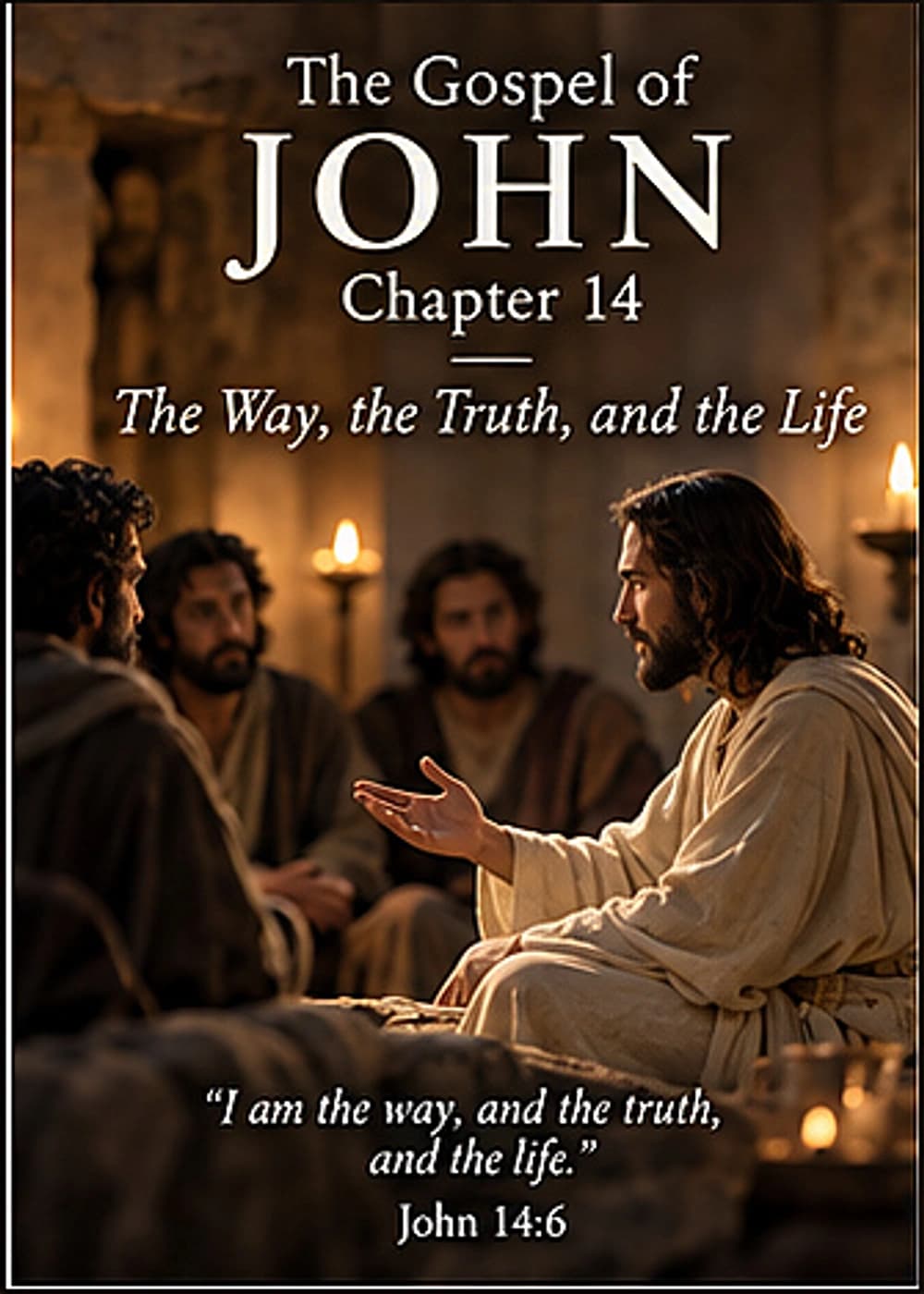
Congregational Course: John
Concordia Seminary, St. Louis
Focused video lessons from Dr. Charles Gieschen and Dr. David Lewis on the text, structure, Christology, signs, glory, and Spirit in John.
Open video resource (opens in a new tab)
Guide to the Gospel of John
BibleProject · Two videos, 8:46 and 8:32
Two concise visual overviews introduce John's literary movement, signs, discourses, death, and resurrection. Use as orientation alongside the site's Lutheran theological study.
Open video resource (opens in a new tab)
Jesus in All of John
Spoken Gospel on YouVersion
Fifteen short, Christ-centered videos cover John in compact passage ranges from the prologue through the lakeside restoration.
Open video resource (opens in a new tab)
Thy Strong Word: Gospel of John
KFUO Radio
A consecutive, pastor-led study through John from the official broadcast voice of the LCMS. Use the collection to find the episode for this chapter.
Open audio resource (opens in a new tab)30 Minutes in the New Testament: John
1517
An accessible Lutheran conversation that begins with John 1:1-18 and continues sequentially through the Gospel.
Open audio resource (opens in a new tab)
Gospel of John Lectures and Studies
Concordia Theological Seminary, Fort Wayne
Dr. William Weinrich's John lectures and focused treatments of passages including John 10 and John 11.
Open audio + video resource (opens in a new tab)
Lectionary at Lunch: John
Concordia Seminary, St. Louis
Exegetical audio on many Johannine lectionary texts, frequently working directly with the Greek for pastors and serious students.
Open audio resource (opens in a new tab)Verse-by-verse Bible study
Read every verse, then follow it deeper
The complete WEB text is always visible. Select a verse for passage setting, themes, exegetical study, theological connections, application, prayer, and supplied Greek text.
The World English Bible text is public domain and reproduced from the official 2020 stable eBible.org source. Study and deep-dive material synthesizes the supplied South Lake Church John compilations and the existing research library. Scripture governs every note.
John 14:1-14
I am the way, the truth, and the life
Jesus anchors troubled hearts in Himself as the only way to know and reach the Father.John 14:15-24
Another Helper
Love for Jesus receives His commands, and the Father gives the Spirit of truth so the disciples are not left orphaned.John 14:25-31
My peace I give to you
The Spirit will teach and remind; Jesus gives peace unlike the world and goes to the Father in obedient love.Natural literary ranges
Passage-by-passage study
John 14:1-14
I am the way, the truth, and the life
Jesus anchors troubled hearts in Himself as the only way to know and reach the Father.- Narrative setting
- The farewell discourse at table.
- Who is speaking
- Jesus, Thomas, Philip
- What is happening
- Promise of the Father's house moves through Thomas's question, the I AM saying, Philip's request, mutual indwelling, works, and prayer.
- What this reveals about Jesus
- Jesus is the Father's perfect revelation and the living way opened through His departure and return.
- What this reveals about the Father
- The Father is not an unknown destination behind Jesus; He is seen and known in the incarnate Son.
Verse-by-verse movement
- Jesus commands trust in God and in Himself.
- He prepares a place and promises return.
- Thomas voices the disciples' uncertainty.
- Jesus identifies Himself as way, truth, and life.
- Knowing Jesus is knowing the Father.
- Philip's request overlooks the revelation before him.
- Father and Son mutually dwell and work.
- Prayer in Jesus' name serves the Father's glory.
Scriptural connections
Old Testament: Exodus 33:18-23; Psalm 27:4
Elsewhere in John: John 1:18; John 10:30; John 20:17
Law
Even disciples can imagine a Father more satisfying than the Son who has made Him known.
Gospel
Jesus prepares a place, returns for His own, and gives Himself as the way home.
Lutheran reflection
The exclusive 'no one comes' and universal invitation of the Gospel belong together: access to the Father is Christ alone, offered in His promise.
Application
Receive Christ's word in faith, then let His gift take form in truthful love toward the neighbor.
Prayer
Lord Jesus, open our eyes to Your glory and keep us in Your word. Amen.
John 14:15-24
Another Helper
Love for Jesus receives His commands, and the Father gives the Spirit of truth so the disciples are not left orphaned.- Narrative setting
- Jesus continues at the table.
- Who is speaking
- Jesus, Judas (not Iscariot), disciples
- What is happening
- The Spirit's indwelling, Jesus' coming, mutual love, and the world's inability to receive are promised.
- What this reveals about Jesus
- Jesus will not abandon His people; by the Spirit He and the Father make their home with those who keep His word.
- What this reveals about the Father
- The Father sends the Spirit at the Son's request and comes with the Son to dwell with believers.
Verse-by-verse movement
- Love and keeping Jesus' commands belong together.
- The Father gives another Helper forever.
- The world cannot receive the unseen Spirit of truth.
- Jesus refuses to leave His disciples orphaned.
- His life guarantees theirs.
- Love receives revelation not displayed on the world's terms.
- Father and Son make their home with the believer.
Scriptural connections
Elsewhere in John: John 7:37-39; John 15:26; John 16:7-15
Wider New Testament: Romans 8:9-17
Gospel
The disciples are not orphans; the triune God comes to dwell with them.
Coram Deo
Keeping Jesus' word is the fruit and shape of receiving His love, not the price paid to make Him come.
Application
Receive Christ's word in faith, then let His gift take form in truthful love toward the neighbor.
Prayer
Lord Jesus, open our eyes to Your glory and keep us in Your word. Amen.
John 14:25-31
My peace I give to you
The Spirit will teach and remind; Jesus gives peace unlike the world and goes to the Father in obedient love.- Narrative setting
- The discourse turns toward departure.
- Who is speaking
- Jesus, disciples
- What is happening
- Teaching, remembrance, peace, joy, prediction, the ruler of the world, and departure converge.
- What this reveals about Jesus
- Jesus gives peace through His word, remains untouched by the ruler's claim, and obeys the Father in love.
- Faith and unbelief
- Jesus speaks beforehand so that the completed event will become ground for faith rather than collapse.
Verse-by-verse movement
- The Spirit will teach and bring Jesus' words to remembrance.
- Jesus bequeaths His own peace.
- Troubled fear gives way to promised return.
- The disciples are invited to rejoice in His return to the Father.
- Prediction serves later faith.
- The ruler of the world has no claim on Jesus.
- Jesus goes so the world may know His love for the Father.
Scriptural connections
Elsewhere in John: John 16:33; John 20:19-23
Christus Victor
The ruler of this world approaches but has no claim on the sinless Son.
Gospel
Jesus' peace is His gift before the frightened disciples can prove steadfastness.
Application
Receive Christ's word in faith, then let His gift take form in truthful love toward the neighbor.
Prayer
Lord Jesus, open our eyes to Your glory and keep us in Your word. Amen.
Gather around the text
Study questions
- What stands out?
- What questions or tensions arise?
- What does this reveal about life with the Father through Christ?
- How does this shape Christian life this week?
Carry Forward
The promised indwelling takes the shape of branches abiding in the true vine amid love, witness, and hatred.
Prayer Focus
For peace in Christ, knowledge of the Father through the Son, and the Spirit's keeping work.
Read Next
Follow the threads
Related paths
Related voices
Conversations
Places
Sources for this study
Holy Scripture governs this study. Later sources illuminate language, history, reception, and doctrine without standing above the text.
- The Gospel according to JohnPrimary source. The governing text for every chapter, structure, claim, and cross-reference.
- World English Bible, 2020 stable Protestant editionPublic-domain English translation. Provides the complete English verse text, reproduced without alteration from the official eBible.org USFM source.
- Supplied critical Greek text of the Gospel of JohnLanguage source. Provides Greek text for every verse present in the supplied edition, normalized only by removing display apparatus marks. John 5:4 is transparently marked as absent rather than reconstructed.
- The Gospel According to John: Exegetical Study, Greek Notes, Law and Gospel, and Teaching CompanionSouth Lake Church study compilation. Synthesized into chapter orientation, verse study, Greek anchors, canonical connections, theological reflection, questions, and application across John 1-21.
- Gospel of John: Exegetical Study, Greek Notes, Law and Gospel, Old Testament Fulfillment, and Conversation ArchiveSouth Lake Church detailed study. Consulted especially for detailed later-chapter exegesis, Law and Gospel, Old Testament fulfillment, teaching prompts, and prayer.
- Gospel of John Conversation Archive and Exegetical StudyProject conversation archive. Used as supporting source material for extended exegetical observations while treating embedded prompts as historical record, not instructions.
- Ancient Christian Commentary on Scripture, John 11-21Ancient Church reception. Used for attributed paraphrases and historical reception in the second half of the Gospel.
- R. C. H. Lenski, The Interpretation of St. John's GospelLutheran commentary. Consulted as a Lutheran exegetical voice, distinguished from Scripture and the Lutheran Confessions.
The supplied copyrighted books remain private research materials. Public pages use original synthesis, short terms, and attributed paraphrase without invented page numbers.